Tuesday, November 14, 2023

DEAD MAN WALKING – REVIEW OF 2023 LIVE FROM THE MET IN HD PRODUCTION

 Reviewed by James Karas

The Metropolitan Opera has started this year’s live transmissions to theatres around the world with Dead Man Walking. It is an opera by Jake Heggie to a libretto by Terrence MacNally and the performance was so powerful I will use a string of superlatives to do it some justice. It is a stunning, emotionally draining and simply great opera that grabs you by the throat in the first minutes and does not release you until the final blackout. It is thrilling.

Dead Man Walking premiered in San Francisco in 2000 and has been produced some 75 times around the world but the fabled Met only got around to producing it this year. With Yannick Nezet-Seguin on the podium, Ivo van Hove as director and a brilliant cast, the production deserves to be described as a masterpiece.

The opera follows the experience of a nun, Sister Helen (Joyce di Donato), who befriends Joseph De Rocher (Ryan McKinny) a convict on death row in the Louisiana State Penitentiary, Angola. She provides him or wants to provide him with spiritual comfort as he awaits his execution amid hopes of a reprieve or a commutation of his sentence. She wants him to tell her the truth, accept responsibility for his actions and seek forgiveness. He is adamant that he did not commit the murder but that it was done by his brother. She is desperately seeking for Joe’s redemption but he can only find it by facing up to the truth.   

Ryan McKinny as Joseph De Rocher and Joyce DiDonato
as Sister Helen Prejean in Jake Heggie's "Dead Man Walking." 
Photo: Karen Almond / Met Opera

There is a heart-wrenching hearing before the Parole Board where De Rocher’s mother (Susan Graham) makes an impassioned and searing plea for clemency to the board. The parents of the two murdered teenagers are there also and their pain and loss leave no room for forgiveness. It is an unforgettable scene.

Ivo van Hove gives the opera a masterly production that deserves the title of work of a genius. He makes liberal use of video projections by Projection Designer Christopher Ash that give clarity and meaning to the production. The performance opens with a video showing a forested area and zeros in on a young couple taking a swim in a lake and then being confronted by two men. The girl is brutally raped and both are killed. It is a harrowing scene.

Projected videos are used throughout the performance to excellent effect giving additional punch to the scenes that we are witnessing. Brilliant.

The vocal and acting performance are of a stature that I have never seen in an opera and rarely in the theatre. Mezzo-soprano Joyce DiDonato who has sung the gamut of opera roles, gives a performance that may well be considered the pinnacle of her long career. The role of Sister Helen makes huge vocal demands as she tries to get to De Rocher’s soul but the emotional stresses as she faces De Rocher’s mother, the parents of the victims and finally the harrowing execution are almost unbearable.

Bass-baritone Ryan McKinny is outstanding as Joseph De Rocher. He is a muscle-bound man who displays bravura in his attempts to deny his guilt and hide his fear. But his fear is palpable and Sister Helen eventually breaks through his defences and reveals his fear and humanity. McKinny gives the angry, frightened and human De Rocher a superb voice as Sister Helen breaks through the convict’s outward denials and gets to his heart and hopes he finds redemption.

Jonah Mussolino as the Younger Brother, Joyce DiDonato as 
Sister Helen Prejean, and Susan Graham as Mrs. Patrick De Rocher
in Jake Heggie's "Dead Man Walking." Photo: Karen Almond / Met Opera

Susan Graham delivers a monumental performance as De Rocher’s mother. She plays a poor and uneducated woman who loves her son. She gives a towering vocal performance that reaches heart-breaking emotional depths as she tries to save her boy from execution. Seeing her in the movie theatre screen in closeups is an advantage over what people who see it live in the huge Met Opera house at Lincoln Centre. I cannot praise her towering performance enough.

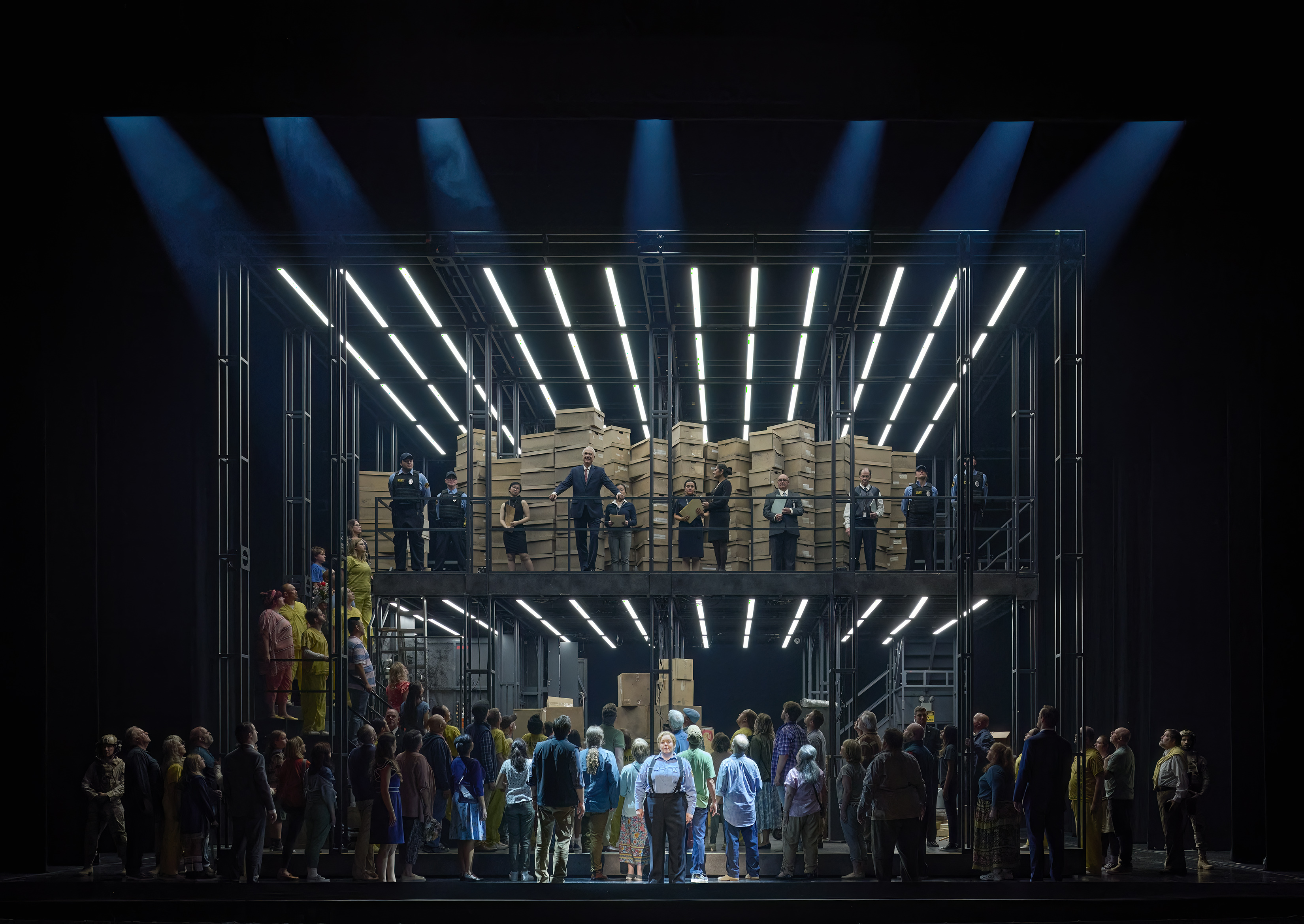
The set and lighting by designer Jan Versweyveld are minimalist. The set for the school where we meet Sister Helen and the other nuns is simply a large room. The same set is used for the prison scenes with different lighting. A large table is brought in for the Parole Board meeting. There are no prison bars or cells. All is sparse but extremely effective.

Yannick Nezet-Seguin conducts the mighty Met Opera Orchestra in a score that carries you through from the first bar to the final note. You may never have heard it before but it is music that is alive and varies as the situation demands and is major part of the great performance.

This is opera at its best.
_____________________
Dead Man Walking by Jake Heggie (music) and Terrence McNally (libretto) was shown Live in HD from the Metropolitan Opera on October 21, 2023 at various Cineplex theatres.  For more information: www.cineplex.com/events

James Karas is the Senior Editor, Culture of The Greek Press

Monday, October 30, 2023

ORPHEUS AND EURYDICE – REVIEW OF 2023 OPERA ATELIER PRODUCTION

 Reviewed James Karas 

Opera Atelier, a prime example of civilization in Toronto, has produced Gluck’s Orpheus and Eurydice for its fall season. There are three versions of Gluck’s opera, the Vienna version of 1762 in Italian, the Paris version of 1774 in French and the Berlioz version of 1859 to a French libretto by Pierre-Louis Moline. Marshall Pynkoski, the Co-Artistic Director of Opera Atelier, has produced all three versions and for this year he has chosen to reprise the Paris version that he directed in 2007 with Colin Ainsworth in the lead role.

Tenor Answorth, still looking boyish, sings Orpheus again this year with soprano Mireille Asselin as Eurydice and soprano Anna-Julia David as Amour. The French version changed the vocal range of Orpheus from castrato to countertenor and now is frequently sung by tenors. Pynkoski has made a major infusion of ballet into the production which fits perfectly with Opera Atelier’s style of providing plenty of ballet dances thanks to Co-Artistic Director and Choreographer Jeannette Lajeunesse Zingg.

It is a beautiful production starting with Ainsworth’s supple lyrical voice and wonderful delivery. The opera has few vocal flourishes for the tenor but he does have to maneuver through deep grief at the death of his wife on the day of their marriage to having to convince the Furies to let him into Hades and then try to endure the temptation to look at Eurydice  on their way out of the depths of Hades to the earth. Alas, he succumbs to her pleas and looks at disastrous results: she dies. Her death does have a positive aspect for us because Gluck composed the beautiful “J’ai perdu mon Euridice” aria that has the distinction of being the first big operatic hit.   

Colin Ainsworth as Orpheus, Mireille Asselin as Eurydice. 
Photo by Bruce Zinger

Asselin has a lovely and delicious soprano voice and we feel her distress as she expresses doubts about Orpheus still loving her when he refuses to even look at her. Excellent work. David does a fine job in the relatively small role of Amour.  

Zingg as expected choreographs gorgeous ballet sequences for the Atelier Ballet. The choruses are handled by the Nathaniel Dett Chorale and the Tafelmusik Chamber Chοir. The inimitable Tafelmusik Orchestra, another mark of civilization in Toronto, is conducted by David Fallis.

Gerard Gauci, Opera Atelier’s Resident Set Designer, designs the set with emphasis on colour, beauty and simplicity. The fires of hell are indicated at the back of the set although there are no dramatic efforts to provide idyllic dales or overdo the terrors of Hades but what we do get is effective.

There was great emphasis on a hazy or foggy Hades. There may have been a hitch, I suppose, and someone kept his finger on the haze making machine for far too long. Some of the dancers were hard to see as were the surtitles above the stage. Much of the theatre was enveloped in haze but I think it was a simple glitch in an otherwise wonderful production.

The Tafelmusik Chamber Choir and the Tafelmusik Baroque Orchestra conducted by David Fallis did superior work.
______________________
Orpheus and Eurydice by Christoph Willibald Gluck opened on October 26 and will run until November 1, 2023, at the Elgin Theatre, 189 Yonge St. Toronto, Ontario, M5B 1M4. www.operaatelier.com

James Karas is the Senior Editor -Culture of The Greek Press

Friday, October 20, 2023

LA BOHÈME - REVIEW OF 2023 CANADIAN OPERA COMPANY PRODUCTION

 Reviewed by James Karas

Puccini’s La Bohème  is one of the most reliable crowd pleasers and the Canadian Opera Company has wisely revived John Caird’s 2013 production again after repeating it in 2019. It is a sound production and was enthusiastically received by the audience. Rightly so.

Any production of La Boheme needs to fulfill certain prerequisites for the audience. We want a lovely, lovable, seamstress named Mimi who just happens to have a beautiful soprano voice and can sing with such passion to make us cry. Egyptian soprano Amina Edris fulfills those requirements quite nicely. She does not have a big voice but she is never not heard and her tenderness from “Mi chiamano Mimi”  to “Addio, senza rancor” (Goodbye without resentment) she delights and moves us.

All her love and passion need a suitable partner and that is the poet Rodolfo who is smitten by her at first sight. They search for her key and he touches her hand and erotic electricity is transmitted as he sings “Che gelida manina” (What a frozen little hand.) Samoan tenor Pene Pati launches into his two-word  (says he) autobiography very quietly and then soars to his high notes. He is a poor poet and dreamer with the soul of a millionaire. Now he sees the beautiful eyes of the seamstress and the rest is operatic eros.   

Pene Pati as Rodolfo and Amina Edris as Mimì in the 
Canadian Opera Company’s production of La Bohème, 2023, 
Photo: Michael Cooper
But she coughs and that’s no ordinary cold. Their love cannot last because Rodolfo cannot afford the medical bills and there is no health insurance on the South Bank of the Seine. But he pretends that the separation is a result of his jealousy and believes that Mimi can find someone who can pay the medical bills. Pati does a good job vocally and he is convincing in his acting. There is not a dry eye in the house during the final scene.

Rodolfo’s three friends deserve praise. The painter Marcello (South Korean baritone Joo Won Kang) is a real mensch who is in love with the flighty Musetta. The philosopher Colline (Congolese bass Blaise Malaba) and the musician Schaunard (Canadian baritone Justin Welsh) make up a fine ensemble of friends and singers. They are the lighter side of the opera with their tomfoolery and enjoyment of life under financially dire circumstances. They are also the support group of the two lovers. Well sung, well played, well done.

A scene from the Canadian Opera Company’s 
production of La Bohème, 2023, photo: Michael Cooper

The singer Musetta (Canadian soprano Charlotte Siegel) is a flirt and superficial seeker of fun. Her aria “Quando me’n vo” (When I walk all alone in the street) expresses her pride in men staring at her. The aria is also known as Musetta’s Waltz expressing her flirtatiousness, energy and love of fun. Unfortunately Siegel fell short of expressing those qualities in her portrayal of Musetta. Her voice, her vivacity and her movements fell short of what Musetta expresses and stand for.

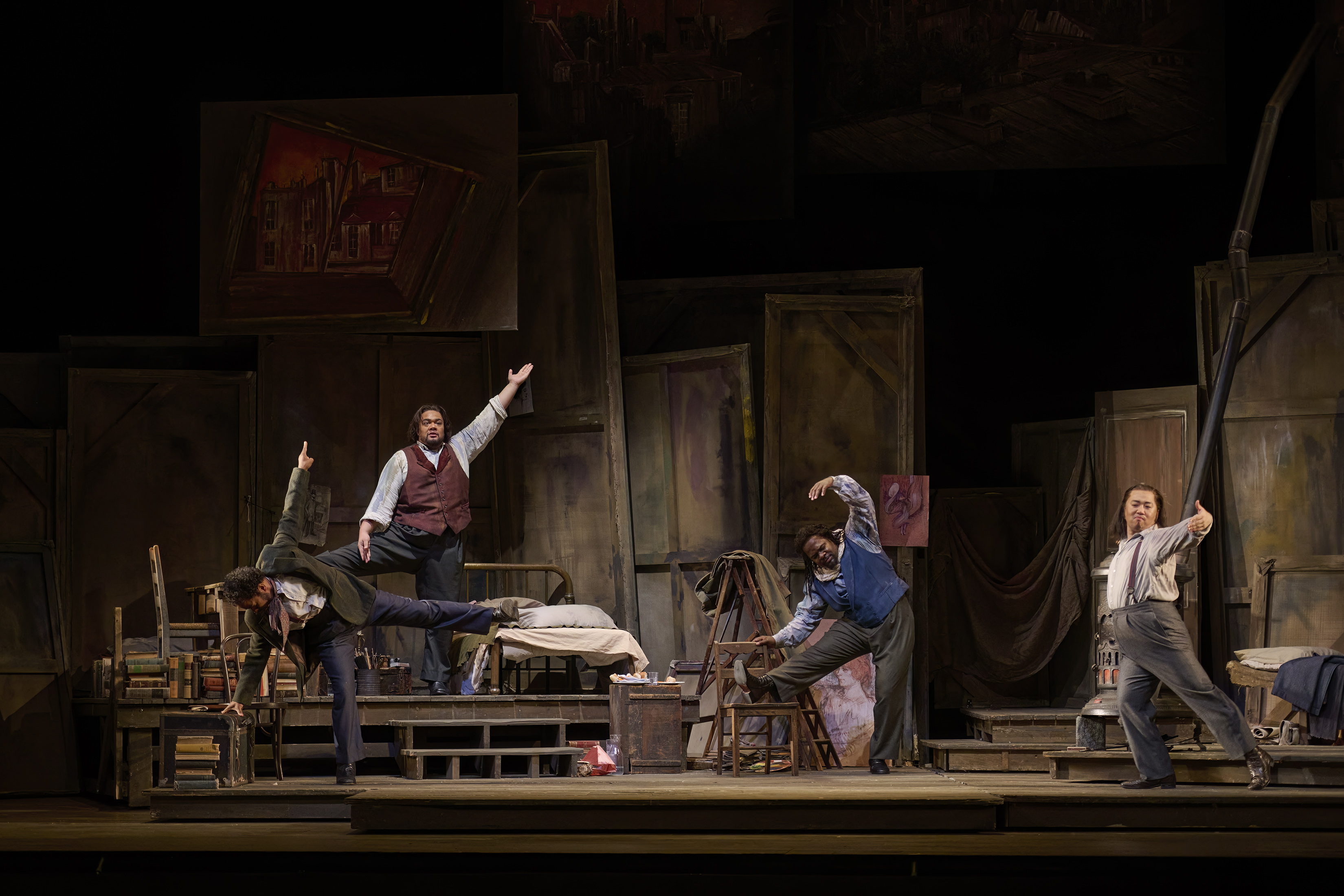
The set by David Farley featured hanging panels with some furniture for the first act. The same panels in a different position and additional furniture made the scene in the café Momus of the second act, not opulent but adequate. The third act near the gates of Paris on a snowy February morning is again adequate but don’t look for too many snowflakes. The set is unimportant. What happens between Rodolfo and Mimi and between Marcello and Musetta and among the friends is what we are focusing on.

Katherine M. Carter is the revival director as she was in 2019 and the production works very well on all levels.

Jordan de Souza conducts conducts the Canadian Opera Company Orchestra in a marvelous performance of Puccini’s wonderful score. 
_______________________
La Bohème  by Giacomo Puccini with libretto by Giuseppe Giacosa and Luigi Illica opened on October 6 and will be performed eight times on various dates until October 28, 2023, at the Four Seasons Centre for the Performing Arts, 145 Queen Street West, Toronto, Ontario.  www.coc.ca

James Karas is the Senior Editor - Culture of the Greek Press

Tuesday, October 3, 2023

FIDELIO - REVIEW OF 2023 CANADIAN OPERA COMPANY PRODUCTION

 Reviewed by James Karas           

After a 14-year hiatus, the Canadian Opera Company brings back Fidelio, in a redoubtable production from San Francisco Opera directed by Matthew Ozawa and conducted by Johannes Debus. It has the vocal strength of the main singers and the powerful set and production designs of Alexander Nichols in a production that deserves to be seen and enjoyed.

Fidelio, as everyone knows, starts as a comic opera, albeit set in a jail, where the jail employee Jaquino (Josh Lovell) pursues Marzellina (Anna-Sophie Neher) with proposals of marriage. She is the daughter of the Chief Jailer Rocco (Dimitry Ivashchenko) and she rejects Jaquino because she is in love with Fidelio. The concern with love, marriage and money takes a sudden and uncomic turn when we learn that Fidelio is in fact Leonore (Miina-Liisa Varela), the wife of Florestan (Clay Hilley) a political prisoner and the victim of Don Pizzaro (Johannes Martin Kranzle), the evil Governor of the prison who wants to get rid of Florestan permanently.

We are rooting for Leonore to free Florestan and the prisoners to serve us with a glorious Ode to Freedom  that we hear in act one and again in a blaze of splendour at the end of the opera.  The COC Chorus gives a stunningly rousing performance.

A scene from the Canadian Opera Company’s 
production of Fidelio, 2023, photo: Michael Cooper

Lovell, Neher and Ivanchenko carry us through the domestic part of the opera with aplomb as we await the more serious business that Leonore is engaged in and the dark side of the opera represented by Don Pizarro. Miina-Liisa Varela has a lovely voice and in the uniform of a modern jail guard with a bullet-proof vest she is able to pretend that she is a man with our approval.

Tenor Clay Hilley as Florestan, kept in the dark dungeon and almost starved, begins his great aria “Gott! Welch Dunkel hier” (“O God! How dark it is!”) softly and rises to its vocal height. A gorgeous rendition. He then sings a beautiful melody where he imagines seeing Leonore (whose image is in fact projected behind him) leading him to heaven. We witness the great joy of the opera when the two finally recognize each other. Sheer magic.

Clay Hilley as Florestan and Miina-Liisa Värelä 
of Fidelio, 2023, photo: Michael Cooper
as Leonore in the Canadian Opera Company’s production 

Ozawa and Nichols have set the opera in a modern American prison. The huge set, placed on a revolving stage resembles an oversized prison with its bars and gates. This is a fitting place for torture and murder in the hands of the suave baritone Kranzle. But all will be solved by Minister Don Fernando (sung by bass Sava Vemic) who arrives just in time to the joy of all. The costumes by Jessica Jahn, as I indicated, resemble those of American police officers or prison guards with guns and bullet-proof vests. 

The COC Orchestra under the baton of Johannes Debus delivers Beethoven’s lyrical and heroic music splendidly and round off a marvelous production.

A superb night at the opera.
___________________
Fidelio by Ludwig van Beethoven in a production from the San Francisco Opera opened on September 29 and will be performed seven times until October 20, 2023, on various dates at the Four Seasons Centre for the Performing Arts, 145 Queen Street West, Toronto, Ontario. www.coc.ca

James Karas is the Senior Editor - Culture of The Greek Press

Monday, August 14, 2023

RINALDO – REVIEW OF 2023 GLIMMERGLASS FESTIVAL PRODUCTION

 Reviewed by James Karas

There are times when you see a production of an opera where the imagination of the director has taken such a leap that it leaves you breathless. It does not happen often but it does in Louisa Proske’s production of Handel’s Rinaldo at the Glimmerglass Festival in Cooperstown, New York.

Rinaldo premiered in 1711 and is an opera seria that was sung by castrati. It has a plot about war, love and sorcery around 1099 during the Crusades. Briefly, the hero Rinaldo loves Almirena, the daughter of King Goffredo. The enemy is led by Argante who is told by the sorceress Armida that the only way he can win is is by capturing Rinaldo. She agrees to capture him herself and she abducts Almirena as well.

Moving on, Argante is in love with Armida and sorceress falls in love with her prisoner Rinaldo, The Christians also have a Sorcerer and, you may have guessed it, Rinaldo and Almirena are rescued and they all live happily ever after,

Handel and his librettist Giacomo Rossi call for a magic castle, a mountain, views of Jerusalem and paraphernalia that Cecil B. de Mille would have been hard put to provide.

Proske and Set Designer Montana Blanco  do away with most of that and leave it to our imagination. The opera opens in a modern hospital room with two youngsters in separate beds, One of  them is unconscious and the other one is awake and dreaming of the heroic deeds of the knights who fought in the Crusades and specifically of Rinaldo. His imagination takes flight and knights jump in through the window of his hospital room. They outfit him as a knight and we see Goffredo outfitted as a leader of the crusades. 

The cast of the 2023 Glimmerglass Festival production of Rinaldo.
 Photo Credit: Evan Zimmerman/The Glimmerglass Festival

The two youngsters become Rinaldo and Almirena. The hospital staff and visitors become the rest of the characters of the opera. The large window at the back is used as a screen for the projection of photographs and videos including a cartoon representation of the climb of Goffredo and his followers up the steep mountain to fight the sorceress, Armida. They are blown away. The Sorcerer on Rinaldo’s side arms them with injection needles  and they go back and blow the Armida side off.

The imaginative transformation of two youngsters in a hospital into the main characters of the opera and the ability to carry the whole idea to the end struck me as brilliant. The opera begins and ends in the hospital room where the hospital staff and visitors who became the medieval characters revert to their modern selves.

The staging and directing are accompanied by some extraordinary singing. The production boasts three countertenors. Even in Handel’s time, the castrati who sang the major male roles were rotated by undamaged singers but for this production Glimmerglass found three outstanding countertenors. Rinaldo is sung by Anthony Roth Costanzo who has a delicate physique and a voice of surpassing beauty and versatility that manages all the trills with utter ease.  The same high praise belongs to countertenor Kyle Sanchez Tingzon  who sings Goffredo as well as countertenor Nicholas Kelliher who sings the smaller role of Sorcerer.

Peter Murphy, Kyle Sanchez Tingzon, Madison Hertel, and Anthony 
Roth Costanzo. Photo Credit: Evan Zimmerman/The Glimmerglass Festiva

Jasmine Habersham sings Almirena in a fine performance. But when it comes to female characters, the show is stolen by soprano Keely Futterer as the sorceress Armida. Dressed in black and accompanied by three Furies dressed completely in black, she plays up the role and manages magical appearances and disappearances as Almirena. A robust and vocally accomplished performance.

Bass-baritone Korin Thomas-Smith sings Argante, the leader of the “other side’ who is in love with Armida. Fine, resonant voice and superb performance.

I make no secret of my admiration of Louisa Proske’s imaginative treatment of the opera. But in all fairness, I should mention that there was a production of Rinaldo at Glyndebourne in 2011 that bears some resemblance to Proske’s It was directed by Robert Carsen and it set in an English private school where the students take on the roles of the opera. It is not as well thought through as Proske’s and the singers are more conventional. But that production is more Monty Python’s Spamalot than Handel.

______________________

Rinaldo George Frideric Handel is being performed five times between July 28 and August 17, 2023, at the Alice Busch Opera Theater, Cooperstown, New York. www.glimmerglass.org

James Karas is the Senior Editor - Culture of The Greek Press


Thursday, August 10, 2023

CANDIDE – REVIEW OF 2023 GLIMMERGLASS FESTIVAL PRODUCTION

 Reviewed by James Karas

The Glimmerglass Festival has chosen to revive Francesca Zambello’s 2015 production of Leonard Bernstein’s Candide for this season. It is an unwieldy and at times difficult work to produce but Zambello managed to bring it together as a well-done satire and opera that thrilled the audience.

It is a robust, fast-moving, colourful and very well-sung production that almost zips you through all the plot complications to the final philosophical conclusion that the work is all about. You may not follow every detail, especially the philosophical backdrop  but you should enjoy the overall production.

And, yes, Candide has a serious philosophical underpinning that is presented through biting satire and comedy. On the more earthy level, there is murder, rape, war, pillage, robbery and a few other such happenings in human life that are a part of the comic operetta. It is based on a novella by Voltaire, after all.

Dr. Pangloss lives in Westphalia with the un-aristocratic Candide (Brian Vu) who loves Cunegonde (Katina Galka), the aristocratic daughter of the Baron of Westphalia (Carlos Ahrens). A commoner loving an aristocratic lady is verboten and Candide is summarily thrown out of Westphalia. Cunegonde joins him. Thus begin his travels around the world. He meets colourful and evil characters and goes through dramatic events in places like Bavaria, Montevideo, Paraguay, El Dorado and Venice. Cunegonde is with him but they are  separated and she is raped by soldiers during a war, he is flogged almost to death and I will not bore you with all the cruelties and examples of inhumanity that the operetta contains. Remember that the intent is a comic and satirical view of human conduct and institutions.

The novella and the comic opera are in the style of a picaresque work that depicts the adventures of a hero like Candide covering numerous episodes across many venues.

Brian Vu as Candide and Katrina Gulka as Cunegonde. 
Photo credit: Evan Zimmerman/The Glimmerglass Festival.

During the travels and various encounters, there is music and numerous songs, of course. Bernstein’s compositions from the now-famous overture to the incidental music to the songs are brilliant, muscular, lyrical, frequently demanding and a feast for the ear. 

The cast is led by actor Bradley Dean, a man of the theatre, who takes on the roles of Voltaire as the host and as Dr. Pangloss, the wise companion of Candide. He is charismatic and a vivacious raconteur who gives a splendid performance.

Candide is the eternal optimist who believes all is done for the good. Yes, we do live in the best of all possible worlds and no facts or disasters can dissuade him from that conviction. Needless to say, it’s all a joke.  Bernstein makes serious vocal demands on Brian Vu as Candide and he performs brilliantly. The same applies to Katrina Galka as Cunegonde who scales her high notes effortlessly and gives us a very admirable heroine.

The 2023 production of Candide. Photo credit:
 Evan Zimmerman/The Glimmerglass Festival.

Our heroes do give as well as take punishment. Dr. Pangloss is sentenced to death and Cunegonde to flogging. She is “shared” by the Grand Inquisitor (Ryan Johnson) and Don Issacar but they are both killed by our stars. The same thing happens to Maximillian when he objects to Candide marrying Cunegonde. Sweet revenge. 

As I said, Candide is based on Voltaire’s 1759 novella. The musical/opera based on it opened on Broadway in 1956 with music by Leonard Bernstein and libretto by Lilian Hellman. It didn’t really work. Since then, it has gone through head-spinning changes and revisions. The Glimmerglass production credits Hugh Wheeler for the book and Richard Wilbur, Stephen Sondheim, John la Touche, Lillian Hellman, Dorothy Parker and Leonard Bernstein for the lyrics.

The current revival of Francesca Zambello’s 2015 production is a lively and colourful Candide that flowed reasonably smoothly despite its unwieldy plot and far too many twists and turns. Eric Sean Fogel’s revival with set designs by James Noone  and costume designs by Jennifer Moeller gives us a coherent and well-sung production. Joeph Colaneri conducts the Glimmerglass Festival Orchestra and Chorus.

 _____________________
Candide by Leonard Bernstein et. al. opened on July 8 and will be performed twelve times until August 20, 2023, at the Alice Busch Opera Theater, Cooperstown, New York. www.glimmerglass.org 

James Karas is the Senior Editor - Culture of The Greel Press

Wednesday, August 9, 2023

LA BOHÈME – REVIEW OF 2023 GLIMMERGLASS FESTIVAL PRODUCTION

 Reviewed by James Karas

The Glimmerglass Festival came to life in 1975 with four performances in the auditorium of Cooperstown High School. Things picked up after that modest start and in 1987 it constructed the Alice Busch Opera Theatre along the shore of Otsego Lake, in the beautiful rolling countryside a few miles from Cooperstown. Yes, that is the one-street town that is famous for the Baseball Hall of Fame and one street full of stores selling baseball memorabilia.

The opera that was produced in the high school auditorium was Puccini’s La Boheme, which happens to be one of this year’s offerings in the 1200-seat Alice Busch Opera Theatre and not in the high school auditorium.

The current production, conducted by Nader Abbassi and directed by E. Loren Meeker, is a pleasure to watch, moving, well-sung, on superb sets. It is pure Bohème without directorial high jinks. Meeker knows the opera well. She directed the original 2016 production at the Glimmerglass Festival and had it set in the Paris of the colourful Belle Epoque of Toulouse Lautrec.    

What do we want? Give us a Mimi that will make Rodolfo  (and us) fall in love with her while searching for her key and make him and everyone in sight bawl in the final scene when she dies. Soprano Teresa Perrotta steps onto the stage to achieve all that. She is a young singer who won the 2023 Grand Final of The Metropolitan Opera Eric and Dominique Laffont Competition. That propelled her into some minor roles until she was cast as Mimi for the Glimmerglass Festival production. 

Teresa Perrotta as Mimi and Joshua Blue as Rodolfo.
Photo credit: Evan Zimmerman/The Glimmerglass Festiva

She has a sweet and affecting voice that makes us love her and cry for her, and root for her when she describes her status as a poor but hard-working and virtuous young woman. She wants her candle lit by Rodolfo, she loses her key and tells us so delicately “Mi chiamano Mimi.” Perrotta carries us along Mimi’s love story, her distress and her fortitude when she separates from Rodolfo with no ill will.

What about Rodolfo, the poor, passionate poet, living in a cold garret in Paris who falls in love with Mimi deeply and forever and leaves her shortly after that.  Tenor Joshua Blue has been around the operatic block a few times and is climbing the artistic ladder with what seems to be a handsome and firm voice. Rodolfo has some fine moments and needs some high notes to express passion, pain and regret. He succeeds superbly. Puccini and his librettists Luigi Illica and Giuseppe Giacosa make him look like a jealous cad who abandons Mimi when he realizes she is seriously ill. But he is no cad. He separates from her because he cannot provide for her. He leaves her so she can find someone who can look after her. A superb performance by Blue.

Rodolfo’s garret mate and two friends do not always get the notice and appreciation that they deserve. True, they are relatively minor characters but they make a significant contribution to the opera. 

The cast of 2023's Glimmerglass Festival production of 
La bohème. Photo credit: Evan Zimmerman/The Glimmerglass Festival

I tip my hat to them and endow them with kudos. We have Darren Lakeith Drone as Marcello, the painter; Justin Burgess as Schaunard, the musician and Nan Wang as  Colline the philosopher along with Rodolfo, of course. Under Meeker’s direction, they make the friendship appear real through thick and thin. They can laugh and find fun in their poverty and stand with Rodolfo and Mimi in her last moments. Fine vocal performances by all.

Kevin Depinet’s sets are perfect for the production. The garret set is a reflection of the artists’ wherewithal, the scene at the Café Momus is colourful, full of activity and carnival joy.

Nader Abbassi conducts the Glimmerglass Orchestra, Chorus and Youth Chorus with vivacity and superb playing.         
___________________________
La Bohème by Giacomo Puccini (music) and Luigi Illica and Giuseppe Giacosa (libretto) opened on July 7 and will be performed thirteen times until August 19, 2023, at the Alice Busch Opera Theater, Cooperstown, New York. More information at: www.glimmerglass.org

James Karas is the Senior Editor - Culture of The Greek Press