Tuesday, July 19, 2022

MOSES AND PHARAOH – REVIEW OF 2022 AIX-EN-PROVENCE FESTIVAL

Reviewed by James Karas

Moses and Pharaoh (or Moïse et Pharaon if you prefer the French title)  is a grand opera by Gioachino Rossini that is rarely produced to the point that many of us have not even heard about it. The Aix-en-Provence Festival has run into the breach by producing a highly creditable production for the post-covid era. 

The opera has many fine points but it also contains some lacunae that will make you scratch your head at three and a half hours of  a performance that starts at 9:30 p.m. It may also test your stamina to stay awake. It is performed at the Theatre de l’Archevêché  with its open roof which means we have to wait for darkness to set in before the performance can begin.

Moses and Pharaoh is about the exodus of the Hebrews from their captivity in Egypt. If you have not read your Bible or seen Cecil B. DeMille’s The Ten Commandments, you should, because you will get a good idea about the plot there. Director Tobias Kratzer and Designer Rainer Sellmaier have a few surprises and some are not pleasant ones.

The opening scene takes place in a modern office where men in modern suits are discussing or negotiating something. They are quite animated but we do not hear what they are saying.

On the left side of the stage, we see a modern refugee camp. The people are dressed reasonably well and there are no signs of despair but they do want to get out of Egypt and go to the promised land of Israel.

One man stands out because he wears a completely different costume from the others and he is none other than Moses. Think of Charlton Heston in The Ten Commandments and you will get a precise picture of what he is wearing. Staff in hand and flowing robe, he looks as if he stepped out of the Old Testament. Michele Pertusi in the role has a marvelous, resonant baritone voice and he exudes authority. We do not argue with Moses  because he also has the ear of God and Pertusi because he has the voice and bearing to perform the role.

Moses and Pharaoh© Copyright: Moses and Pharaoh
by Gioacchino Rossini – musical direction Michele Mariotti – 
staging Tobias Kratzer – Festival d'Aix-en-Provence 2022 © Monika Rittershaus

We know something about the negotiations and miracles preceding the exodus of the Hebrews from Egypt but Luigi Balocchi and D’Etienne de Jouy, Rossini’s librettists have added a love interest. Anna (I am using the English names of the characters for convenience), Moses’ niece is madly in love with Amenophis, the son of the Pharaoh! Is she going  to give up her faith or will he renounce his pharaohship and trek across the desert to Israel?

Soprano Jeannine De Bique as Anna has a marvelous voice and she can leap across octaves like Superman can leap to the top of buildings. Not always in complete control but she still delivers a highly accomplished perfromance. Samoan tenor Pene Pati has a supple voice that reminded me of the youthful Juan Diego Florez but again with some control issues.

Mezzo-soprano Vasilisa Berzhanskaya as Amenophis’ mother Sinaide turns in perhaps the best performance of the night especially in her rendition of  “Ah, d’une tendre mère,”  in which she implores her son, tenderly and lovingly, to forget Anna and marry the  Assyrian princess chosen for him. It is a long recitative and aria and Berzhanskaya gives a bravura and memorable rendition.

Bass-baritone Adrian Sampetrean gives a solid performance as the troubled Pharaoh  who is buffeted by a desire to keep the Hebrews and the powerful miracles performed by Moses’ God.  He is responsible for some of the plot twists such as promising to let the Hebrews go and then going back on his word. Moses has God’s ear and he asks and gets some pretty awful stuff, like plagues, drought, floods and very destructive storms.

The production has some graphic videos of droughts, floods and storms, all shown to us on television news reports.

The Egyptians are not convinced and they gather in a temple to praise the mother of the goddess Osiris. They have dancers to entertain them and we are treated to an interminable ballet. The faithful in the temple start fidgeting (or is it my imagination?) the Pharaoh gets up and with every such move we think the dance is over. But it is not.

The Pharaoh finally relents and lets the Hebrews go. We have to get the parting of The Red Sea and the exit from Egypt. As we all know the Red Sea will part and we see it doing just that on a powerful video. This may not be de Mille, but it is impressive enough.

The Egyptians decide to give chase and we see men in suits and smartly dressed women in high heels running across the desert to catch the Hebrews. No horses, no soldiers just people from their office jobs running to catch up with enemy. It’s all on video of course. They catch up and the Red Sea engulfs them. We get some dramatic views of people swimming, sinking and eventually their corpses floating on the water.

It is a memorable production with some superb singing and interesting ideas. But women in high heels chasing the Hebrews across the Red Sea? No need to worry about it, I suppose. We know the Hebrews made it.

Michele Mariotti conducted the Lyon Opera Orchestra with enthusiasm in an outstanding performance.

_________________

Moïse et Pharaon ou Le Passage de La Mer Rouge by Gioachino Rossini opened on July 7 and will be performed a total of six times until July 20, 2022, at the Thêâtre de l’Archevêché, Aix-en-Provence, France. www.festival-aix.com

Wednesday, July 13, 2022

SALOME – REVIEW OF 2022 AIX-EN-PROVENCE FESTIVAL PRODUCTION

Reviewed by James Karas

The 2022 Aix-en-Provence Festival is back with a full program of operas and concerts in the gorgeous medieval city. Richard Strauss’s Salome opened the opera season with a production by Andrea Breth featuring the 31-year-old soprano Elsa Dreisig in her debut performance in the title role. There were some marvelous moments and some worthy of complaint.

Let’s start with what I thought was the best part of the production and of Dreisig’s singing. In the final minutes of the opera, Salome has her wish and demand for the head of Jochanaan – John the Baptist – fulfilled when it is delivered to her on a silver platter or a shield, if you are picky. It is the ultimate gratification and ultimate disappointment for her and Dreisig has to express both in powerful and emotional singing. Jochanaan rebuffed her when she wanted to kiss him but now, she can kiss him and bite him like some fruit. But he is dead, and his wild eyes are closed. There is triumph and defeat for the young girl who fell in love with the wild Prophet. Dreisig’s voice soars with anger and emotion and expresses deep regret in a singular rendering of the recitative/aria.

Unfortunately, that does not hold true for Dreisig’s performance throughout. She does not have a big voice and on some occasions, she was drowned out by the orchestra, and she compared uneasily with the other singers who outvoiced her. Breth presents Salome as a teenager with Herod, her stepfather, lusting after her while she develops a passion for the imprisoned Baptist. She is a sweet girl who sings very beautifully but a bigger voice would have been nice. But she rose to the occasion in the last minutes of the production in a bravura performance.

© Copyright: Salomé by Richard Strauss – musical direction Ingo Metzmacher – 
staging Andrea Breth – Festival d'Aix-en-Provence 2022 © Bernd Uhlig

Andrea Beth’s production was interesting if not entirely satisfactory for other reasons. The opening is somewhat confusing as we settle in for a dark and foggy set showing the open cover of a tomb, or maybe a cistern in this case. The scene which is supposed to be on a terrace lasts for forty-five minutes and only Salome is lit by the moon. After a while you want to see what is going on, more than you want to appreciate the director’s vision, or the set designer’s (Raimund Orfeo Voigt) and lighting designer’s (Alexander Koppelmann) view of the darkness of the soul.

For the party scene, the set consists of a gray backdrop with a large table where Herod and his guests sit for the banquet. It is not much of a banquet or a party. Everything happens behind that table until Salome agrees to satisfy her stepfather Herod’s request for a dance at any price.

Salome’s dance, with or without seven veils, is traditionally a very important part of the opera. With Breth’s vision of Salome as a young, innocent girl, perhaps we are not entitled to expect a sexually charged dance that would satisfy Herod’s lust. We get almost nothing. Choreographer Beate Vollack produces four Salomes doing some steps, but it is a long way from any kind of dance. Is it because Dreisig cannot dance or did Breth think what we see qualifies as Salome’s Dance? It does not.

The other central motif of the opera is the decapitation Jochanaan and the presentation of his head to Salome. There may be a decapitation but there is no head visible. All that Salome gets is a large bucket and we assume that the Baptist’s head is in it. She sticks her head in the bucket to give the much-desired kiss on the mouth to Jochanaan and comes out with blood on her face. We saw Jochanaan’s head at the beginning of the performance when he looked out from the cistern and the reason for not showing us his head after it was severed from his body is a mystery to me.

The other singers deserve unstinting praise. Tenor John Daszak heroically sings the dirty-minded Herod. Herodias is his wife, the mother of Salome and the former wife of his brother. Yes, welcome to Hamlet. Angela Denoke is a first-rank soprano who sings marvelously and illustrates how she was able to nab her brother-in-law after her husband “disappeared”.

Strauss’s third opera has some wild music that the Orchestre de Paris under the baton of Ingo Metzmacher played with great fervor and volume. The one-act opera lasts for about one hour and forty minutes with no intermission. It is based on Oscar Wilde’s play of the same name  

__________

Salome by Richard Strauss opened on July 5 and will be performed a total of five times until July 19, 2022, at the Grand Theatre de Provence, Aix-en-Provence, France. www.festival-aix.com

Wednesday, May 11, 2022

THE MAGIC FLUTE – REVIEW OF CANADIAN OPERA COMPANY’S 2022 PRODUCTION

Reviewed by James Karas

When Papageno, the naïve and loveable bird catcher, sees the pretty Papagena who is to become his wife, he exclaims a loud and gleeful WOW. That is what tenor Gordon Bintner does in the current production of The Magic Flute presented by the Canadian Opera Company at the Four Seasons Centre in Toronto.

WOW is the most precise and laudable review one can give to a performance. There is a problem with using that word as the definitive and only description. No, not for the performers but for the critics who would join the unemployment line and the papers that may have to deal with blank  pages. Fortunately for reviewers and unfortunately for performers, WOW is rarely used as a definitive judgment of a production. Alas, the same applies to this production of Mozart’s sixteenth opera. It has some virtues but for some reason it simple fails to grab us.

This is a revival of the COC’s  2011 production of The Magic Flute which was originally directed by Diane Paulus. The same production was staged in 2017 and is currently revived by Anna Theodosakis.

Paulus presents the opera as a play-within-a-play. In a program note she states that “The entire play-within-a-play is presented in the open space of a nobleman’s garden, itself a place of enchantment and symbolic power during this historical period.” The story is enacted in an elaborate labyrinth of hedges on the grounds of the estate. It is a good idea and a fine place to enact a fairy tale.

Set and costume designer Myung Hee Cho handles numerous scene changes from gardens, to mountains, to groves, to Temple of Wisdom astutely and economically with lighting changes and moveable hedges.

I should declare my view of the opera. It was first produced in 1791 in the Theatre auf der Wieden, outside of Vienna and its censors. The libretto was by Emanuel Schikaneder, a man of the popular theatre. He was interested in making money and not producing high art. The Magic Flute is a Singspiel, a play with songs or simply a popular musical. It may have some of Mozart’s best music and contains some highfalutin ideas about wisdom, goodness, bravery and some other virtues practiced by Masons. That sounds heavy-handed but it is not because the music and beautiful songs do not allow it to become anything but wonderful and there is hilarious comedy to carry you to the triumphal end.

Diane Paulus’s production does not fully succeed as such. When Papageno yells WOW at the sight of Papagena he gets a big laugh but Paulus does not take advantage of the many opportunities for comedy in the opera. Papageno’s attempt at suicide, should have the audience roaring with laughter. Here it produced a little more than polite enjoyment. No fault of Bintner who needed better direction to be hilarious.

The quality of the singing had some inevitable variations but it was overall very sound. Caroline Wettergreen gets high marks for surviving the tortuous Aria of the Queen of the Night. Yes, that’s the one that has a two-octave range and she expels those high Fs as if they were poisoned arrows. But go past that and look at her daughter Pamina’s reactions as the Queen demands that she kill her father and, far worse, the vile and malevolent curses that she spouts if she fails to do so. Wettergreen deserves to be judged with the power of her performance and not just the high notes. She is brilliant overall. 

She contrasts beautifully with her estranged husband Sarastro sung by bass David Leigh.  

Dressed in gold, he is the epitome of wisdom and rectitude. He sings “O Isis und Osiris” and “In diesen heil’gen Hallen” with steady resonance and sonority and we enjoy every note of them.

Our hero Tamino was in the hands and vocal chords of tenor Ilker Arcayűrek while the heroine Pamina is assigned Anna-Sophie Neher. They both have lovely voices and we share in their “suffering” as they are sorely tried as they progress through the hardships on their way to the Temple of Wisdom which I translate to be as a happy marriage and a happy life.

The COC Orchestra and Chorus shone under the baton of Patrick Lange.

The problem was that on the day I saw it, the performance seemed to be weighed down and did not engage the audience. The curtain calls’ reactions ranged from polite to positive was with some nuggets of enthusiasm.  

As I said, Papageno’s WOW got one of the biggest laughs. How I wish I could have reviewed the entire production with that one word.

______________________

The Magic Flute by W. A. Mozart (music) and Emanuel Schikaneder (libretto) is being performed seven times from May 6 to 21, 2022 at the Four Seasons Centre, 145 Queen St. West Toronto. www.coc.ca

Tuesday, March 29, 2022

ARIADNE AUF NAXOS - REVIEW OF MET OPERA PRODUCTION TRANSMITTED LIVE IN HD

 Reviewed by James Karas

The transmission of live performances from the Metropolitan Opera is back and a redoubtable production of Ariadne auf Naxos was available in theatres across Canada on March 12, 2022. We are amid an invasion of Ukraine by Russia and the event is uppermost in many people’s minds. Host Matthew Polenzani expressed his support for the Ukrainian people and the Met’s General Manager Peter Gelb did the same at greater length. He did not mention it, but the Met has cut off ties with Russian supporters of Putin including superstar Anna Netrebko. Bravo to the Met.

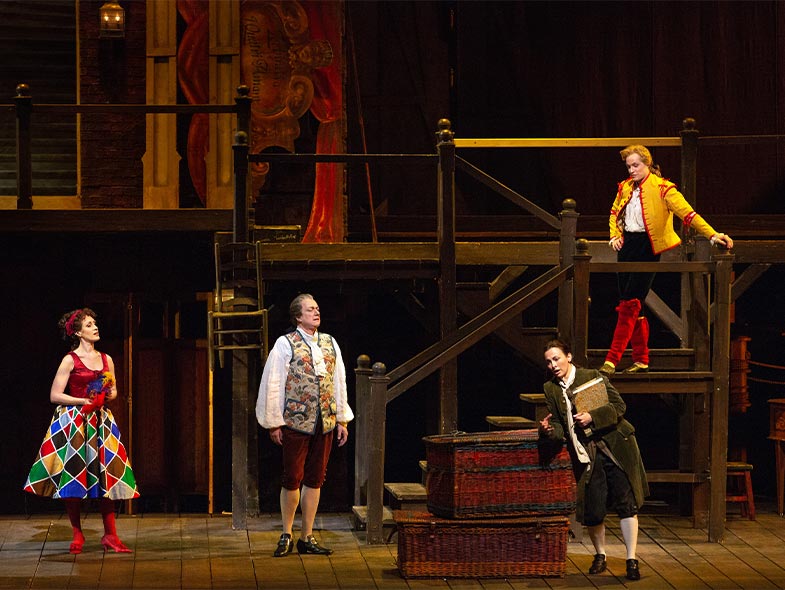
Elijah Moshinsky’s impressive 1993 production of Ariadne auf Naxos has been brought back by revival director Stephen Pickover with a splendid cast and it is a musical and vocal stunner.

Composer Richard Strauss and librettist Hugo von Hofmannsthal had the ingenious idea of merging low comedy with high opera or commedia dell’arte with Mozarto-Wagnerian high art and, depending on your taste, you may find it exhilarating or a work with an identity issue.

In any event, the richest man in 18th century Vienna is feasting his friends to a lavish dinner and subsequent entertainment with performances of a tragic opera, a musical comedy and then fireworks. Time becomes tight and the host orders that the tragedy and the comedy be performed together lest time runs out for the fireworks.

In the Prologue we meet the artistes of the comedy and the tragedy feuding and throwing temper tantrums at the suggestion that their pieces are to be cut short and performed simultaneously with the other. The Prima Donna (later Ariadne, sung by the inimitable Lise Davidsen) has a fit and the Composer (Isabel Leonard) goes ballistic. But the latter calms down and the lovely-voiced Leonard sings an exuberant paean to the sacred art of music.

The opera of the title begins and we find the distraught princess Ariadne on the island of Naxos. She saved Theseus from the man-eating Minotaur in Crete and he promised her the world and then dumped her on a desert island. Lise Davidsen sings the melancholy “Es gibt ein Reich” (There is a kingdom) where she imagines a quiet place of death. Strauss and von Hofmannsthal find a way of getting her off Naxos in a happier mood than Theseus left her.


The orchestra and the superb cast give us an outstanding production but the star is unquestionably soprano Lise Davidsen. She has a luscious and expressive voice and she displays her low notes and her ability to leap to the high notes in a single phrase with impeccable ease. This is an Ariadne to take her place in the pantheon of memorable singers.  

The final duet sung by Davidsen and tenor Brandon Jovanovich as Bacchus is a marvel of sustained vocal achievement and musical beauty. Jovanovich uses his vocal prowess and dexterity to bring Ariadne out of her catatonic morass and lead her into the sunset and perhaps apotheosis. Bravura singing.

Ariadne’s companions on the island are three nymphs, a Nyad (Deanna Breiwic), a Dryad (Tamara Mumford) and Echo (Maureen McKay). They are put on stands well above the stage floor and look as if they are wearing long dresses. They are beautiful and dramatic.

The comedians are kept busy trying to entertain the unhappy Ariadne. Their leader Zerbinetta (done to perfection by Brenda Rae) works the hardest. Rae has the movements and mannerism of a natural comic and she can sing. Zerbinetta and her talented and acrobatic troupe, Harlequin (Sean Michael Plumb), Truffaldin (Ryal Speedo Green), Scaramuccio (Alok Kumar) and Brighella (Miles Mykkanen) do their best. Rae sings Zerbinetta’s signature aria “O great princess” with flair and humour. She tells Ariadne that men are faithless monsters and she does not subscribe to fidelity by any measure. It seems that only a god can convince Ariadne.

The sets by Michael Yeargan consist of two areas. The Prologue is the basement of the house of the richest man. We see the large staircase on the side and that tells us where we are. For the scene on Naxos, we see the area for Ariadne’s “cave” with lighting changes and room for acrobatic activities by the comedians.

Ariadne auf Naxos has a complex score that reaches back into operatic history and with Wagnerian connections. Marek Janowski conducts the Met Opera Orchestra in a performance that can serve as a full concert.

___________

Ariadne auf Naxos by Richard Strauss was transmitted Live in HD from the Metropolitan Opera on March 12, 2022, at various  Cineplex theatres. An encore will be shown on April 9, 2022. For more information: www.cineplex.com/events/

James Karas is the Senior Editor - Culture of the Greek Press. This review appeared in the newspaper first.


Wednesday, February 10, 2021

THE MAGIC FLUTE - REVIEW OF STREAMING OF PARIS OPERA PRODUCTION

James Karas

The Magic Flute was the brainchild of Emanuel Schikaneder, an extraordinarily talented man of popular theatre in Vienne in the latter half of the 18th century. That happens to coincide with the life of Mozart and Schikaneder wanted to put together a money-making singspiel based on his libretto for his Theatre auf der Wieden in a suburb of Vienna.

The opera with singing and spoken dialogue had other contributors to the libretto including fairy tales and a healthy dose of the philosophy of freemasonry. The Magic Flute opened on September 30, 1791 and was a big hit. It would almost certainly have joined the countless other hits of the era on the dusty shelves or dustbins of history were it not for the magical music composed by Mozart.

Some 230 years later, the Paris Opera has produced the work in an empty Opéra Bastille trying to observe some Covid-19 protocols. The effects of the disease are everywhere, and the news delivers frightful numbers of infections and deaths. Director Robert Carsen’s 2014 production zeroed in on the idea of death in general and in the opera in particular and it inadvertently takes full cognizance of what is happening during the current pandemic. The idea and the reality of the death of millions of people is all around and a more appropriate production can hardly be found.

In the opening scene our hero Tamino collapses near some mounds in the clearing of the forest. The mounds will turn out to be graves. The nasty Monostatos who will try to rape the lovely Pamina is a gravedigger. Graves will appear several times in the production as will a human skeleton and a skull. No one will miss the reference to the gravediggers’ scene from Hamlet when a skull is greeted with the words “Alas, Poor Yorick!” The appearance of coffins, black costumes and funereal veils will impress on us the idea of death.

Carsen uses modern costumes almost entirely black or white in conjunction with death as well as the moral lessons of the opera. The Magic Flute is a morality tale. Light, white, love, virtue, truth, and good are posed against darkness, black, hatred, vice, lies and evil. That is what fairy tales tell us and the freemasons, we suppose, stand for.

In the background we have the projection of a green forest. Its colours will change to brown, snow-covered white and barren to indicate the passage of time and the change of the seasons.

An aggressive morality tale amidst graves and coffins could be a fail-poof formula to keep people away from a production even during a lockdown. This production is nothing of the kind. It stands as an interesting view of the opera and a sheer pleasure to watch and hear.

The cast may not be from the top tier of singers, but their performance is superb. Tenor Cyrille Dubois is the heroic Tamino and he does a fine job in the role. He pursues the lovely Pamina, sung by soprano Julie Fuchs with a delicious voice and youthful ardour.

The comic relief is provided by the agile and irreverent Papageno of bass-baritone Alex Esposito who has made a career of singing comic character roles and he makes it perfectly obvious why in this performance.

Soprano Nina Minasyan is the Queen of the Night and she handles the regal rage and leaps across the two octaves of her mainstay aria. Sarastro (bass Nicolas Testé) is her opposite as the symbol of love and wisdom that he displays with sonorous beauty in his fine arias "O Isis und Osiris" and ‘In diesen heil'gen Hallen.”

The grave-digging, shovel-carrying and would-be rapist Monostatos is in the hands of Wolfgang Ablinger-Sperrhacke. Carsen does not overdo him because someone who tries to rape a woman does not need to be exaggerated.

The orchestra and chorus of the Paris National Opera were conducted by Cornelius Meister. 

Performing to an empty house during a pandemic has definite drawbacks. All involved, including the orchestra try to wear masks. That works for the strings, but the wind instrument players can’t very well blow in a flute. The chorus wears masks and sings with gusto. I could not tell if they were pre-recorded or if they managed to sound that good with their mouths covered. The main singers did not wear masks and social distancing was not exactly adhered to.

Whether you absorb the masonic virtues of strength, goodness, veracity, love and wisdom is up to you. You should enjoy this production done under difficult circumstanced, regardless of your moral standards. 

__________

The Magic Flute by Wolfgang Amadeus Mozart is streamed by the Opéra national de Paris until February 22, 2021 with some cast changes. For more information visit: https://chezsoi.operadeparis.fr/products/the-magic-flute or  https://www.operadeparis.fr/

Friday, December 18, 2020

MADAMA BUTTERFLY – REVIEW OF GREEK NATIONAL OPERA PRODUCTION

By James Karas

This is a review of Madama Butterfly produced by the Greek National Opera and streamed around the world.

No, that is not a misprint. There is a Greek National Opera (GNO) that is alive and kicking. It has a stunning new home in the Stavros Niarchos Foundation Cultural Centre in Athens, and it is has produced and telecast a redoubtable production of Madama Butterfly. More about Greek opera later.

Performances of Madama Butterfly started in October and a recording was made in November just before all events were cancelled due to Covid-19. To their great credit they have decided to stream the recorded performance and remind us of the existence of the Greek National Opera.

The production features Albanian Soprano Ermonela Jaho as Cio-Cio San (Madama Butterfly), the 15-year-old Japanese geisha who falls hopelessly in love with Lieut. Pinkerton of the United States Navy. She delivers a splendid Cio-Cio San. Not only does she sing with sterling vocal beauty but invests the role with emotional depth that is exhilarating and heart-breaking. We see the happy bride who is in love and will do anything to please her lover. In “Un bel di vedremo” she imagines Pinkerton’s return after having been abandoned three years before. There is longing, playfulness, beautifully imagined happiness, all done superbly by Jaho.

Ermonela Jaho as Madama Butterfly

The tragic end is yet to come when she realizes the extent of Pinkerton’s perfidy and she has to give up her son and then her life. A performance full of vocal beauty and pathos.

Italian tenor Gianluca Terranova played Pinkerton as an arrogant, self-centered, amoral, “ugly American” who “marries” a young girl to satisfy his lust. Butterfly is a temporary wife, and he can get rid of her on a month’s notice when he has a real wedding with an American girl. Terranova is fine as a swaggering scoundrel and his voice soars to the high notes of his braggadocio. Director Hugo de Ana has him dressed all too casually in an open shirt and slacks. It does not quite befit a lieutenant in the U.S. Navy who is most likely to wear a dress uniform.

Baritone Dionysios Sourbis as the American Consul Sharpless appears more nervous than sympathetic at the start, but he eventually sings and acts like a mensch when the extent of Butterfly’s tragedy strikes him in the face.

Mezzo-soprano Chrysanthi Spitadi deserves kudos for her performance as Butterfly’s faithful servant Suzuki. She sees and knows the truth and tries to help the besotted Butterfly. A completely sympathetic character done well by Spitadi.

Hugo de Ana gives us a classic, conservative production that has many fine details. For example, Butterfly has an icon, a rosary and wears blue jeans. She has renounced her entire cultural background to become an American wife and please Pinkerton. The final scene is done with deep pathos with Butterfly’s suicide handled with effectiveness and restraint.

De Ana goes overboard with some of his costumes for Butterfly’s visitors. Yamadori (Marios Sarntidis) and Bonzo (Yianni Yannisis) don huge, ridiculous wigs. The rest are mostly tasteful and there are some beautiful Japanese costumes.

The set is fairly Spartan but appropriate with skeletons of structures and backdrops indicating the port and appropriate lighting. There is judicious use of video projections especially during the interminable intermezzo.

Lukas Karytinos conducted the Orchestra of the GNO. Because of Covid-19, the size of the orchestra was reduced but it still sounded excellent. Unfortunately, there seems to be a problem with the hall’s acoustics. While the orchestra sounded fine, there was a difference in volume coming from the stage. The singers were never overwhelmed but there were times when it was difficult to hear them. When the main characters sang at full throttle, there was no issue. At other times there was.

Giorgos Koumendakis, the GNO’s Artistic Director, advises that more productions will be televised starting January 2021. That is an incredible step forward for Greek culture.

The Greek National Opera was formed in 1939 and it had its first production on October 25, 1940. In attendance were numerous notables including the Italian Ambassador to Greece, Emanuele Grazzi. He is the one that three days later, in the middle on the night of October 28, 1940 visited Dictator Ioannis Metaxas and delivered Italy’s ultimatum. By the morning, Greece had entered World War II. This production of Madama Butterfly marks the 80th anniversary of the 1940 opening.

There have been many productions since 1940 but very few have merited international attention. A young girl named Mary Kalogeropoulos sang on its stage during the war. She left Greece and went to Italy and became Maria Callas. There are many world-class singers and musicians, and all should be brought to Athens to make the world notice the GNO.

The GNO already has a large roster of in-house singers, dancers, musicians and behind-the-scenes personnel. It promises to telecast more productions to the world. We wait with anticipation and hope.  _______________

Madama Butterfly by Giacomo Puccini is being streamed by the Greek National Opera. For more information go to:  https://www.nationalopera.gr/ or  https://tv.nationalopera.gr/


Monday, December 14, 2020

TOSCA – 1978 MET PRODUCTION STREAMING AND MUCH MORE

 Reviewed by James Karas 

Have you heard or seen Tosca recently? How many times? Have you heard Maria Callas in her 1953 recording?

New York’s Metropolitan Opera offered us another chance to see Tosca by streaming its 1978 production. It is part of its daily streaming of productions new and old during the pandemic. It is a redoubtable show by any standard, but you may wish to complain about the pre-digital age video. You should not.

Tosca requires three topnotch singers: a soprano, a tenor and a baritone. With some exaggeration one can state that almost every topnotch soprano, tenor and baritone has recorded Tosca, many more than once, but more about that later.

Maria Callas

The production streamed for us featured Shirley Verrett as Tosca, Luciano Pavarotti as Cavaradossi and Cornell MacNeil as Scarpia. That is star power. Verrett started as a mezzo but had the high notes to sing soprano roles and she does a stunning Tosca. She has a richly toned voice and dramatic talent, and her Tosca has grand emotional depth and strength. She is coy and jealous in the beginning but progresses into a woman who is deeply in love in the duet with Cavaradossi. Her “Vissi d’arte” is almost a prayer and we relish her murder of Scarpia as she glorifies in her stabbing and cries “Muori donato! Muori, Muori!”

Luciano Pavarotti, who dominated the tenor repertoire, made his Met debut in the role of the heroic Cavaradossi. He sings with ease and assurance and his splendid middle range is a delight while the high notes seem to come effortlessly. Much younger then, he is physically adroit and gives us a memorable Cavaradossi.

Cornell MacNeil was one of the foremost baritones of the era and interestingly was directed by another outstanding Scarpia – Tito Gobbi. Gobbi sang Scarpia in perhaps the greatest recording of Tosca, the one with Maria Callas in 1953. MacNeil as Scarpia is made to look like Gobbi did in the role especially in the 1964 production at Covent Garden. That production, with Maria Callas of course, was directed by Franco Zeffirelli part of it is available on YouTube.

Gobbi’s adept production is Zeffirellian in its approach. He wants us to see details of the church in the first act and the room in the Palazzo Farnese in the second act as well as a giving us a good impression of the Castel Sant’ Angelo in the third act.

Zeffirelli produced his version of Tosca at the Met in 1985 and it was revived numerous times for the next 25 years. It starred Hildegard Behrens, Placido Domingo and Cornell MacNeill. It is lavish, opulent, stunning, vocally and physically. Enough said. Just see it.

Zeffirelli’s unforgettable production was replaced by Luc Bondy’s staging in 2009 and it was roundly booed. In 2017 Bondy’s production was replaced by one directed by David McVicar. The latter avoided Bondy’s pitfalls and gave a traditional production laden with many fine details that made it look fresh. It was a success.

Opera listeners come in several categories. Normal people who see and listen to standard repertory productions. They come in various gradations of dedication to the art. In the other extreme are the opera buffs or aficionados. There dedication has no bounds – they are nuts – who want every recording of their favourite opera or singer and argue about her high notes, his wobbly low notes and everything in between.

If you see one production of, say, Tosca, you want to see a couple more, no? Yes. But which one do you choose? In 1978, a critic reviewed recordings of Tosca and listed a mere 24 complete recordings starting in 1920. That is a pittance, and most aficionados would have had no difficulty acquiring most of them. Digital recordings, videos and streaming arrive, and the number of recordings goes through the roof. It seems that there are more than 250 recordings of Tosca today. Trying hearing, seeing or buying most of them!

But mention Tosca and all afficionados will immediately point to the 1953 Callas, Gobbi and Giuseppe di Stefano recording. It is spectacular in every aspect and listening to the enhanced CD has the advantage of letting you imagine the action. As I said almost every soprano has recorded Tosca and you will not go wrong with Leontyne Price, Renata Tebaldi, Montserrat Caballe and many others. But like a Muslim going to Mecca, you cannot go though life by not hearing that recording.

There is no shortage of Tosca recordings available on DVDs and on YouTube. In 1976 Gianfranco de Bosio made a notable film with Raina Kabaivanska, Placido Domingo and Sherril Milnes in the main roles. It has the advantages of a movie without interfering with the music or the libretto We see the exteriors and interior of Sant’ Andrea Della Valle Church, get a view of the Palazzo Farnese as well as the Castel Sant’ Angelo. The great scenes are a bonus to the stunning performances of the young singers. A couple of hours well spent.

But things do not always work out. If you want to see the “big names” together in a production that stinks, see Tosca in the 2000 production at the Teatro dell’ Opera di Roma. The stage looks like something you find in a high school auditorium. It has no real orchestra pit and the musicians are encroaching on the playing area which is tiny. The set is pathetic, what you can see of it when the camera is not relentlessly zeroing in on the faces of the singers.

 It was the 100th anniversary of the opera and Franco Zeffirelli directed it. He did not have much to work with and crammed whatever he could on the tiny stage. Venezuelan soprano Ines Salazar as Tosca sang forcefully and well but she looked like she just stepped out of the shower and had no time to do her hair. Luciano Pavarotti sang Cavaradossi and wowed the audience. They gave him thunderous applause and Juan Pons was Scarpa. Fine singing but simply awful production values.

Covid-19 is making life hell but a few hours with Tosca, Maria Callas and a few others like her and life will seem a lot better.

____________________________

James Karas is the Senior Editor - Culture of The Greek Press. This review appeared first in the newspaper