Friday, June 17, 2016

PHILIPPOS ALEXANDROS – REVIEW OF KASSARAS’ OPERA IN THESSALONIKI PRODUCTION

James Karas

Philippos Alexandros by Sarantis Kassaras (music and libretto)
Directed by Theodoros Pantsios

Philippos                     George Sofialidis
Alexandros                  Apostolos Sotiroudis  
Olympias                     Anila Teli                                
Diogenes                     Yiannis Chouliaras                 
Demosthenes              Theodoros Pantsios
Dancer                         Konstantina Chouliaras
First Chorus Leader     Yiannis Vagienas
Second Chorus Leader Kostas Mylopoulos

Performed once on June 5, 2016 at the Vasiliko Theatro,
Thessaloniki, Greece
_____

Greek opera?

Callas, Souliotis, Paskalis, Baltsa, Theodossiou. That is not a bad list of Greek singers in opera even if some of them are slightly hyphenated.

Oh, you want Greek operas? The Greek National Library has hundreds of them but the chances that you have heard or seen many of them are not great. Let’s face it, Greek opera can best be described by that fine Hellenic word oxymoron. It is a contradiction in terms.

But don’t tell composer Sarantis Kassaras that. He composed Philipos Alexandros in 1994 and the opera was not performed until December 2015 when the Greek Community of Luxembourg staged it for the first time. The opera received its Greek premiere on June 5, 2015 at the Vasiliko Theatro Thessalonikis as part of the First International Conference of the Alexander Son of Philip Greek Macedonian Society (SAFEM).

The production was an unexpected bonus at a conference dealing with the legacy of Philip II and his son Alexander the Great. The plot deals with the relationship between the two great men and the dream of uniting the Greeks under one leader to confront the mighty Persian Empire.

Apostolos Sotiroudis as Alexander is a scrawny youth who handled the vocal demands of the role without exuding heroic prowess. Baritone George Sofialidis commanded authority vocally as King Philip although I could have done without the gold leaves on his head representing his royal crown, no doubt.

Soprano Anila Teli as Oympias had a formidable regal bearing with a strong upper register and fine vocalizing throughout. Yiannis Chouliaras with his gravelly voice was a fine comic representation of Diogenis the Cynic who told Alexander to step aside because he was shading the sun.

Theodoros Pantsios in a dramatic red tunic looked every inch the fiery Athenian orator who hated the Macedonians.

The opera has a male and a female chorus. The women wore lovely white dresses of classical design that matched their voices very nicely. The men wore a motley of cloaks slung over their shoulders but sung quite well.

Kassaras’s music has traditional and modern elements. There are strong rhythmic elements as well as melodic pieces. The music is scored for piano (played by the composer who also conducts the performance), harp (Yiota Miserli), trumpet (Kostas Damianidis), saxophone (Tetiana Masmanidou) and percussion (Stefanos Gazilas). The players are from the Orchestra of the Association of Musicians of Northern Greece. The Vasiliko Theatro has no pit and the orchestra played from the side of the ample stage.

The opera was directed by Theodoros Pantsios. It has elements of baroque chamber operas in its structure and some static features.

There is a handful of opera productions in Athens but almost none in Thessaloniki, Greece’s second largest city. The production is worth praising for that alone but for much more as well.

Oxymoron can mean sharp-dumb. If Kassaras had his choice he would remove “moron” from the issue of opera in Greece and make it a more familiar element in the Greek cultural landscape.

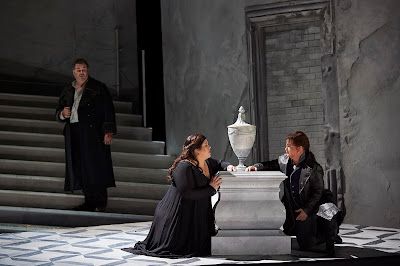

Tuesday, June 14, 2016

ELEKTRA – REVIEW OF LIVE FROM THE MET PRODUCTION

James Karas
ELEKTRA by Richard Strauss

Directed by
Conducted by
Set Designer
Elektra
Chrysothemis
Clytemnestra
Aigisthus
Orestes
Patrice Chereau.
Esa-Pekka Salonen
Ruchard Peduzzi
Nina Stemme
Andrea Pieczonka
Waltraud Meier
Burkhard Ulrich
Eric Owen
Few sopranos possess the platinum lung power (steel is just not good enough) and the acting ability to handle Strauss’s Elektra. The performance is in effect an extended Mad Scene. The somewhat unhinged daughter of Agamemnon has been discarded from the royal household where her mother Clytemnestra and her new husband Aigisthus hold court. Her father was brutally murdered by Clytemnestra after his return from Troy with his concubine Cassandra. The soprano who can handle the role is Nina Stemme.

The opera opens in the courtyard of the palace where some servants are throwing chickenfeed and filling buckets of water. Another servant is sweeping the steps. It is an ordinary scene that we need to absorb until Elektra steps on the stage. What does the director for cinema Gary Halvorson do? He zeroes in on these meaningless activities as if we need close-ups of the servants and what they are feeding the chickens. This is ridiculous. We need to see the whole tableau before we observe the daughter of the great Agamemnon dressed basically in rags staring at us, clearly disturbed.

Stemme dominates the opera from the beginning as the dispossessed and bitter woman, through to her encounters with her haunted mother, to her hope for the return of her brother Orestes and her triumphal dance upon the murder of Clytemnestra and her Lover Aigisthus.

It is s searing and towering performance. We see her madness in her eyes, her face, and hear it in her voice that cascades towards us with power and amplitude.

Adrianne Pieczonka has a smaller role as Elektra’s sister Chrysothemis but she does not back off from delivering a similarly powerful performance.

Waltraud Meier as Clytemnestra is a slim and attractive as the woman who got a lover while her husband was at war in Troy and murdered him on his return. She is haunted and terrified of the consequences. She knows that if her son Orestes returns he will likely wreak vengeance on her and her lover. Meier shows us Clytemnestra trying to deal with all her ghosts while attempting to maintain her outward assurance. Again an astounding performance.

Eric Owens with his rumbling bass voice is the avenging Orestes. His fine voice stands him well but Owens lacks the vengeance and wrath required of Orestes. He is a nice guy not a retributive son.

Patrice Chereau first staged this production in 2013 at Aix-en-Provence. It is dome on a bare set consisting of a grand arch serving as the entrance to the palace and little else on the stage. There is a hole in which Elektra crawls and the modern ragamuffin costumes of the servants are appropriate without for his view of the opera.

Strauss’s music in all its power is delivered by The Metropolitan Opera Orchestra under the baton of Esa-Pekka Salonen. The emphasis of the production and the performance is Elektra and with Stemme the in the title role the performance simply epochal.

Opera at its best
__________.          

Elektra by Richard Strauswas shown Live in HD on April 30 and broadcast again on June 11, 2016 at select Cineplex Cinemas. www.cineplex.com/events

Friday, May 6, 2016

MAOMETTO II – REVIEW OF CANADIAN OPERA COMPANY PRODUCTION

James Karas

MAOMETTO II by Gioachino Rossini. Luca Pisaroni (Maometto II), Leah Crocetto (Anna), Bruce Sledge (Erisso), Elizabeth DeShong (Calbo), Charles Sly (Condulmiero). Conductor Harry Bicket. Director David Alden. Set & Costume Designer Jon Morell. Until May 14 2016 at the Four Seasons Centre, 145 Queen St. West Toronto. www.coc.ca

**** (out of five)

When you see an opera that was first performed in 1820 getting its premiere with the Canadian Opera Company, your only response should be to line up for tickets. Maometto II has its shortcomings, no doubt, but it gets a highly creditable production by the COC that succeeds in most departments.

The COC uses the production created by Santa Fe Opera directed by David Alden with Set and Costume Designs by Jon Morrell. If you are looking for another Barber of Seville, you are in the wrong place. This is Rossini waxing dramatic, melodramatic and long.
 
(l-r) Bruce Sledge as Paolo Erisso, Leah Crocetto as Anna and Elizabeth DeShong as Calbo 
in the COC’s production of Maometto II, 2016, photo: Michael Cooper
After the fall of Constantinople in 1453, the Ottomans plan to invade Western Europe. But first they must defeat the Venetians who control Negroponte, the gateway to the Western Mediterranean. The Ottomans are led by the dashing Sultan Maometto II (Mehmed or Mohammed) sung by the dashing bass-baritone Pisaroni. Except for the minor character of Selimo (Aaron Sheppard) and the soldiers from the Ottoman side, Rossini and his librettist Cesare della Valle focused their attention on the Venetians.

Militarily, the Venetians are toast and they sing of dying in a blaze of glory. All of which would make a very short opera except for the fact that Anna, the daughter of Erisso, the Venetian Commander, is in love. She fell in love with Uberto who turns out to have been a disguised Maometto. She is intended for General Calbo, a pants role in which American mezzo-soprano Elizabeth DeShong excels.

The Ottomans defeat the Venetians and the commanders are taken prisoners. As you may have guessed, the passionate Anna of soprano Leah Crocetto learns of her error and is not prepared to marry the infidel Maometto who still loves her. A tragic end ensues.

Aside from the love interest, Maometto II espouses a martial ethos with an emphasis on heroism in battle, glory in death and patriotic zeal that is exaggerated even by operatic standards. The creaky plot is exacerbated by Rossini continuing with and repeating phrases long after we got the gist of them. That is how he gets more than three hours.

But that is only part of the story. There are splendid arias and ensemble pieces. The COC chorus as Turks or Venetians does superb work. The richly orchestrated music is impressive and done rousingly by the COC Orchestra conducted by Harry Bicket.

Alden attempts to keep the dramatic and eschew the melodramatic elements of the opera. Pisaroni is sonorous without becoming stentorian. Crocetto is expressive without excess. DeShong is terrific with her marvellous low register. Tenor Bruce Sledge leads in extravagant heroism both vocal and military while Charles Sy’s Condulmiero recommends surrender with fervour.    

Black and grey are the dominant colours with versatile, grey monumental panels serving as a backdrop. The costumes of the Venetians look like World War I vintage but they could be of another era. The Venetians have rifles with bayonets whereas the Ottomans are sporting spears, shields and swords. This is not particularly clear.    

Maometto II ends on a note of self-sacrifice, heart-wrenching tragedy and indeed apotheosis. That may be one of its many virtues (musically it is decidedly so) but it had many detractors when it was first produced, so many in fact that Rossini rewrote it with a happy ending. That did not save it.

We are luckier. This is a very worthwhile operatic experience and damn the opera’s defects and its detractors

Wednesday, February 10, 2016

THE MARRIAGE OF FIGARO – REVIEW OF CANADIAN OPERA COMPANY PRODUCTION

Reviewed by James Karas

Claus Guth, the director of the current production of The Marriage of Figaro for the Canadian Opera Company tells us in a note that “he wanted to follow the characters into their darkest psychological depths.” He has found the shortest route to making one of the most enjoyable of operas into a dreary three and a half hours despite some excellent singing.

Let’s start with the set by designer Christian Schmidt. It consists of a grand but unadorned staircase. This bottom of the staircase is supposed to be Figaro’s room where he takes measurements for his bed while Susanna is showing her new hat. He is not really measuring and she does not have a hat. The set for the Countess’s bedroom in the next act is an unadorned room without a stick of furniture. Has the Count invested his money in oil or perhaps subprime mortgages and fallen on bad times? Guth created this production in 2006 for the Salzburg Festival     
 
A scene from The Marriage of Figaro, 2016, photo: Michael Cooper
Guth introduces a new character into the opera, “a kind of Eros angel” he calls him. This is an athletic youngster, played by Uli Kirsch, with white wings who appears regularly. Initially he is mildly annoying but progresses into a major nuisance and ends up as a pain in the ass.

The Marriage of Figaro has a good opera buffa plot with some very traditional motifs: the clever servants outwitting their masters; the course of young love obstructed by the old; the lost child reunited with his parents. All of these have existed since the dawn of comedy. Mozart’s music raises this conventional plot into something magical and thoroughly entertaining.   

Figaro (sung by Josef Wagner) is a lovable rascal, clever on his feet and getting married to Susanna (Canadian soprano Jane Archibald) who is smarter than him. Wagner does deliver a good Figaro but he would have done much better, along with everybody else, if Guth had not hung a millstone around his neck not the least of which is Eros. We love Susanna because she is pretty, clever and sings marvelously – Archibald does, that is.

Baritone Russell Braun could be a perfect Count Almaviva if he did not have Eros climbing all over him. Almaviva is a petulant, jealous, selfish and shallow aristocrat who becomes bored with his wife and wants to seduce her maid. He is motivated by lust and not by love. He is not conflicted; he is just plain horny. But he does grow and in the end is capable of going down on his knee and asking for forgiveness in a sonorous voice full of nobility and gracious contrition. 
 
                                 Josef Wagner as Figaro and Uli Kirsch as Cherubim (Eros). Photo: Michael Cooper
Cherubino, the testosterone cannon kid, is a juice pants role for a mezzo-soprano. Guth has mezzo Emily Fons dressed in a school uniform looking like a twelve-year old who should be doing homework instead of zipping up his pants. Fons is forced to look unpleasant and unconvincing even if vocally quite accomplished.

Soprano Erin Wall as the Countess sang her big arias beautifully and movingly. She plays with her wedding dress on the steps when singing “Dove sono” but the  splendour of the aria and her voice beat all.

Bartolo (Robert Pomakov), Don Basilio (Michael Colvin), Marcellina (Helene Schneiderman) are stock comic characters who are usually left lone by Eros and it is all for the better. They do a fine job as good singers and comic characters.

Johannes Debus conducted the COC Orchestra for the marathon performance.

There is no shortage of bold, imaginative and one may say unorthodox productions of Figaro. Peter Sellars placed it in the Trump Tower in New York with some major tweaks; Nicholas Broadhurst and Geoff Posner transferred it to the house of Sir Cecil Portico (Count Almaviva) in England at the time of the Faulklands invasion. The countess sings in English from her Lifestyle treadmill. Director John Dew decided that the Countess is an alcoholic. There are numerous such takes but most of them do not stray from the central fact that this is a comic opera even if it has some interesting social angles.

Guth’s forced interpretation reminds me of Freud’s comment about cigars. A cigar may look like a phallic symbol and psychiatrists can go to market analysing the simple pleasure of smoking. Freud’s comment was that a cigar is sometimes just a cigar. Guth should have taken the hint that an opera buffa is sometimes just an opera buffa and not an exploration of comic characters’ psychological depths.
      _________

The Marriage of Figaro by Wolfgang Amadeus Mozart opened on February 4 and will be performed in repertory until February 27, 2016 at the Four Seasons Centre for the Performing Arts, 145 Queen Street West, Toronto, Ontario. Tel:  416-363-6671. www.coc.ca

Saturday, February 6, 2016

SIEGFRIED – REVIEW OF CANADIAN OPERA COMPANY PRODUCTION

James Karas
           
The Canadian Opera Company is continuing the revival of its 2006 productions of The Ring of the Nibelungs, minus Das Rheingold. Last year we saw Atom Egoyan’s production of Die Walküre and this year we are offered Francois Girard’s production of Siegfried.  

One of the most striking and memorable features of the production is the set in the first act. A jumble of people, statues, miniature buildings and objects are suspended in midair above the stage. Some of the singers are lowered onto the stage by guy wires from there and you get the impression of an aerial Siegfried. More about this below.  

Christopher Purves (right) as Alberich in the COC production of Siegfried, 2016. Photo: Chris Hutcheson
The singing is of high caliber. German tenor Stefan Vinke tackles the demanding title role. Siegfried goes from a petulant, childish, vengeful and scornful youth at the beginning to the heroic being who finds love. Vinke acts with panache and sings dramatically and in the final duet with lyrical intensity to give us a first rate Siegfried.

American bass-baritone Alan Held is impressive as The Wanderer a.k.a Wotan. With his resonant voice, his feet firmly on the ground, he exudes authority and power amid fear of losing both.       

From the bad guys, baritone Christopher Purves and bass Phillip Ens were strikingly successful as Alberich and Fafner respectively. They exuded creepy nastiness vocally and physically. The same cannot be said of Wolfgang Ablinger-Sperrhacke’s performance as Mime, the dwarf who raised Siegfried. The latter admits that he learned a great deal from Mime except how not to loathe him. Admittedly Siegfried is being a bit of a creep perhaps but I think Mime is supposed to be a slithering, slimy creature. In this production Ablinger-Sperrhacke makes him almost sympathetic. He should make him disgusting. No complaints about Ablinger-Sperrhacke’s vocal performance.

Brűnhilde’s appearance in this opera is relatively short but she comes on at the end and she and Siegfried sing the final duet that is absolutely stunning. Just listen to soprano Christine Goerke and Vinke. There is an explosion of testosterone on Siegfried’s part; discovery of divine passion, acceleration, deceleration, bursts of lyricism – this is the pinnacle of opera. You arrived at the theatre at 6:30 and were told the opera ends in five hours. After this marathon duet you wonder where the time went.         
Stefan Vinke as Siegfried and Christine Goerke as Brünnhilde.  Photo: Michael Cooper
Director François Girard with Set Designer Michael Levine and Lighting Designer David Finn want an atmosphere of darkness even when, for example, Siegfried sings of the sunny summit, hails the sun that shines and Brűnhilde sees the day shining bright in the sun. There is a spot light where the happy couple sings of sunshine but there is darkness all around.

With the exception of Brűnhilde, all the characters, from The Bear to The Forest Bird are dressed almost identically in white. The Bear is lowered from above and lands behind Siegfried who is sitting on a huge stump. We are grateful for a human bear rather than an oversized teddy-bear that can look simply ridiculous.

When The Wanderer goes in search of Erda he stops by a circle of rocks from whence one would expect Erda to emerge. She does not and we find her sleeping on the floor, stage right.  A simply curious effect by Girard. But let’s give credit to contralto Meredith Arwady who has some rich low notes as the Earth goddess in a scene that is lousy on plot but rich in music.       

The singing and production values are only a part of the opera and perhaps even more important is the music. No opera house should think of staging Wagner without a first rate orchestra. The COC Orchestra conducted by Johannes debus was superb.

We can discuss directorial choices until the cows come home but who has cows in Toronto anyway. The result is an overall resoundingly successful production.   
_________
Siegfried by Richard Wagner opened on January 23 and will be performed seven times on various dates until February 14, 2016 at the Four Seasons Centre for the Performing Arts, 145 Queen Street West, Toronto, Ontario. Tel:  416-363-6671. www.coc.ca

Friday, February 5, 2016

SALOME – REVIEW OF DEUTSCHE OPER BERLIN PRODUCTION

James Karas

When the curtain went down at the end of the performance of Salome at the Deutsche Oper Berlin, soprano Allison Oakes who sang the title role stepped out for a bow. She was greeted with a widespread chorus of boos.

The gentleman who was sitting beside me leaned forward and put his head between his hands. The applause of the audience became polite and even enthusiastic when the performers took their bows and they applauded Oakes positively if not enthusiastically. My neighbor (unknown to me) refused to lift a finger of approval and I finally asked him how he would rate the production on a scale of 1 to 10. He expressed a fervent wish that he had missed it completely.

Scene from Salome at Deutsche Oper Berlin. Photo: © 2016, Monika Rittershaus
I found it riveting.

If you want to be negative, Claus Guth’s production can be described as unorthodox, confusing, taking liberties with the libretto and creating a Salome like you have never seen before. All of that is true and the result is an outstanding and brilliant interpretation of the opera.

Salome is based on Oscar Wilde’s play in which Salome, Herod’s step-daughter and niece is sexually attracted to Herod’s prisoner, John the Baptist (called Jochanaan in the opera). Herod is married to Herodias who is Salome’s mother and the former wife of his brother. He is sexually attracted to Salome to the point where he considers replacing her mother with Salome as the queen. No wonder the Baptist is fulminating about the cesspool of sin that this family represents.

All of it is very dramatic with some wild music by Strauss. It is a one-act opera that lasts for about one hour and forty five minutes (no intermission) and keeps you on the edge of your seat.  

Guth turns the character of Salome and the opera inside out. There are seven Salomes representing her from childhood into adulthood. Only one of them sings but her younger versions are very much around and they participate in Salome’s famous dance.

Most of the minor characters are in effect robots. They move mechanically like robots and in fact there are a couple of mannequins on stage.

The Baptist is the wild, fulminating prophet in the opening scene. He lies on a pile of clothes (at first I thought they were corpses), almost naked. He is brought out of the dungeon at Salome’s insistence and he joins a party thrown by Herod. Herod seems to own an upscale men’s clothing store. The men are dressed in dapper suits and when the Baptist joins them, several Salomes dress him up in a three-piece suit identical to the one worn by Herod. His hair is combed the same way and Herod and the Baptist become identical.     

                                  Scene from Salome at Deutsche Oper Berlin. Photo: © 2016, Monika Rittershaus
John is decapitated but not in the way we are used to seeing. I will not give more details about that and spoil the possibility that you will see the production or a recording of it. To delve into all the possible psychological issues of Salome in her relationship with her stepfather and John would require a lengthy essay and not just a review.

German baritone Michael Volle with his powerful and expressive voice sang the key role of the Baptist. German tenor Burkhard Ulrich sang Herod, the businessman with the illicit lust for his niece/stepdaughter who is willing to give up half his “kingdom” for a dance. Soprano Jeanne-Michèle Charbonnet took the role of Herodias, dressed in black she looks like a woman who scored a rich husband and enjoys her position of wealth and power.

The singing was quite exceptional with a minor note. Catherine Naglestad was scheduled to sing the title role but she was replaced at the last minute by Allison Oakes. She has a superb voice but there was an issue of the orchestra almost drowning her out on occasion. This may be simply a lack of time to adjust the balance between stage and pit and it should not detract from an outstanding performance.

The Deutsche Oper Orchestra was conducted by Alain Altinoglu and it delivered Strauss’s score in all its intricacies with heroic assurance.

In short, this is a Salome that is profoundly original, perhaps disturbing to some but in the end it represents opera at its intellectually most exciting.
__________

Salome by Richard Strauss opened on January 24 and will be performed on February 6, April 2 and 6 at the Deutsche Oper Berlin, Bismarckstrasse 35, Berlin.


Monday, February 1, 2016

LOHENGRIN – REVIEW OF DEUTSCHE OPER BERLIN PRODUCTION

James Karas

When the lights go up for the opening of Lohengrin at the Deutsche Oper Berlin and Wagner’s taut music fills the auditorium, we see a stage strewn with the corpses of soldiers. Several women appear and they go from corpse to corpse trying to identify the dead person. Eventually one of them recognizes a dead person and she gives a heart-wrenching scream.

Photo: honorarpflichtig / Protected by copyright
This is the image that director Kasper Holten and designer Steffen Aarfing want us to keep in mind as we watch Wagner’s “romantic opera” as he called it.

Lohengrin has a romantic aspect and an almost comic one according to Holten but it is also about national unification, love, betrayal and war. Holten tells us about all of these but he wants us especially to remember war.

Swedish tenor Michael Weinius gives a fine accounting of himself in the title role. His voice has the amplitude and fortitude for the part but he does not quite strike the heroic model that one envisions for the knight of the grail. The fault may not be entirely his. As we know, Lohengrin arrives on the scene to defend Elsa in a boat drawn by a swan. He bids farewell to the swan upon alighting from the boat but Holten puts the wings of a swan on him and he wears them throughout the performance. He looks like an angel and I have some reservations about that appearance.

American Soprano Rachel Willis-Sorensen sings the pure and virginal Elsa. In this production she walks on the stage blind-folded and of course launches into “Elsa’s Dream” almost immediately. This is sung in a reverie of remembrance and pain and it is her defining aria. Elsa will show spunk when dealing with Ortrud but she will return to the same mode in the end. Willis-Sorensen shows depth of emotion and tonal beauty in a sterling performance.

Russian mezzo-soprano Anna Smirnova can shoot poisonous darts wrapped in honey as the evil Ortrud. She plays an ambitious and conniving Ortrud that could give instruction in evil to Lady Macbeth. Vocal strength and projection of evil like guided missiles.

German baritone Thomas Johannes Mayer was all ambition and bluster as the evil Friedrich von Telramund who wants to usurp Brabant. He is under the thumb of his truly evil wife Ortrud and he seems to have less  cruelty than Macbeth but a much nastier wife than the hapless Scottish king. Mayer sang even though he had a cold. He deserves credit for so doing.

Baritone Bastiaan Everink was suitably stentorian as the Herald and Austrian bass Albert Pesendorfer was sonorous and regal as King Henry.

Lohengrin has some powerful choruses and the Deutsche Oper Chorus was supplemented by the Extra chorus for a performance that was simply overwhelming. Together with the Deutsche Oper Berlin Orchestra under Donald Runnicles, they, as they say, brought the roof down.

Back to the conception and design features. As I said we have the rather bizarre situation of Lohengrin who is so assiduous and unforgiving about his identity, going around with the wings of a swan on his shoulders. He should be gloriously heroic and look a bit less incongruous.

The stage in the first act is bare except for the soldiers who are dressed in khaki or gray. They are soldiers from any era. The main characters wear more traditional, perhaps medieval attire.  In the second act there is a raised platform on which Elsa stands and when she descends from it we can see that it is in the form of a cross. There is a bright red curtain and the image of a cathedral in the second act. After the magnificent wedding procession Lohengrin and Elsa end up in what should be their honeymoon suite but it consists of only one bed. Despite all the elevated love, Lohengrin shows that he a frisky young man as he gets rid of his wings, his sword and his robe and prepares for something more earthy. It got a laugh.

Elsa is under the influence of Ortrud and asks for the one thing Lohengrin cannot give her. The rest is a disastrous end for Elsa but a great evening of opera for the audience.  
__________

Lohengrin  by Richard Wagner opened on January 31 and will be performed on February 14 and May 5 and 8, 2016 at the Deutsche Oper Berlin, Bismarckstrasse 35, Berlin.
http://www.deutscheoperberlin.de/